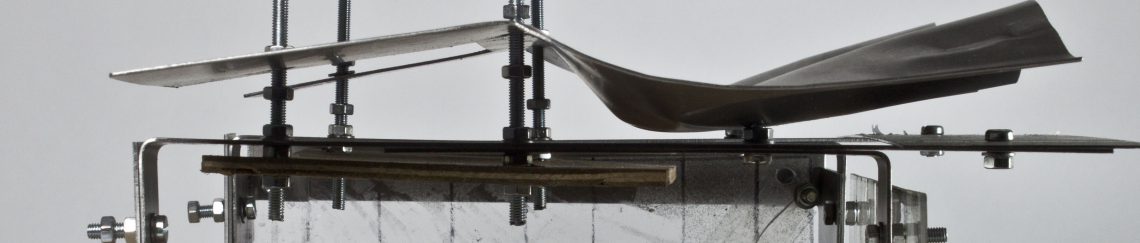
no.balsa is an approach applied in teaching architecture, design and art. It revolves around intuitive making by hand.

Above: Tactile objects hung in the dark, Paul Neagu, 1969
The idea originates from experimental model-making workshops organised at the University of Westminster and Universidad SEK in Quito (Ecuador). In these workshops, students made physical representations of abstract ideas and experimented with materials not conventionally used for architectural model-making. The objects built by students were unplanned and positively surprising results were achieved through experimentation.
Following the initial workshops, an enquiry was made into the psychology behind the exercises. Carl Jung’s idea of Active Imagination was identified as the most relevant framework. During the workshops, one’s unconsciousness ‘interacts’ with the particularities of the materials and objects one was faced with, resulting in unexpected results. A similar creative process happens in a psychoanalytical Active Imagination session through the use of drawing, dance, or other artistic media (Jung & Chodorow, 1997; McNiff, 1998).
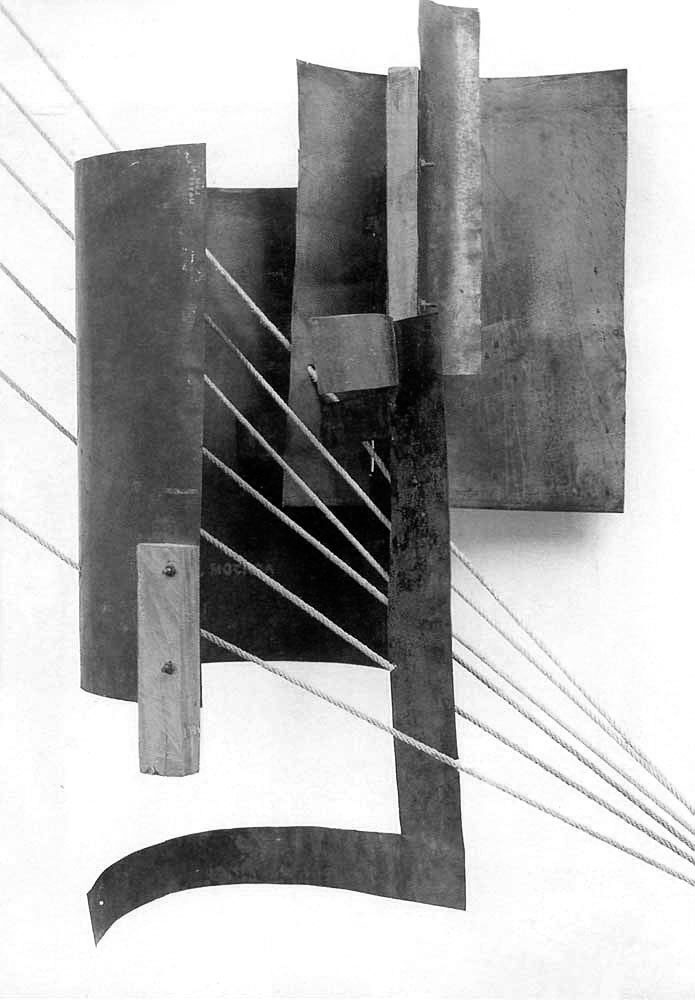
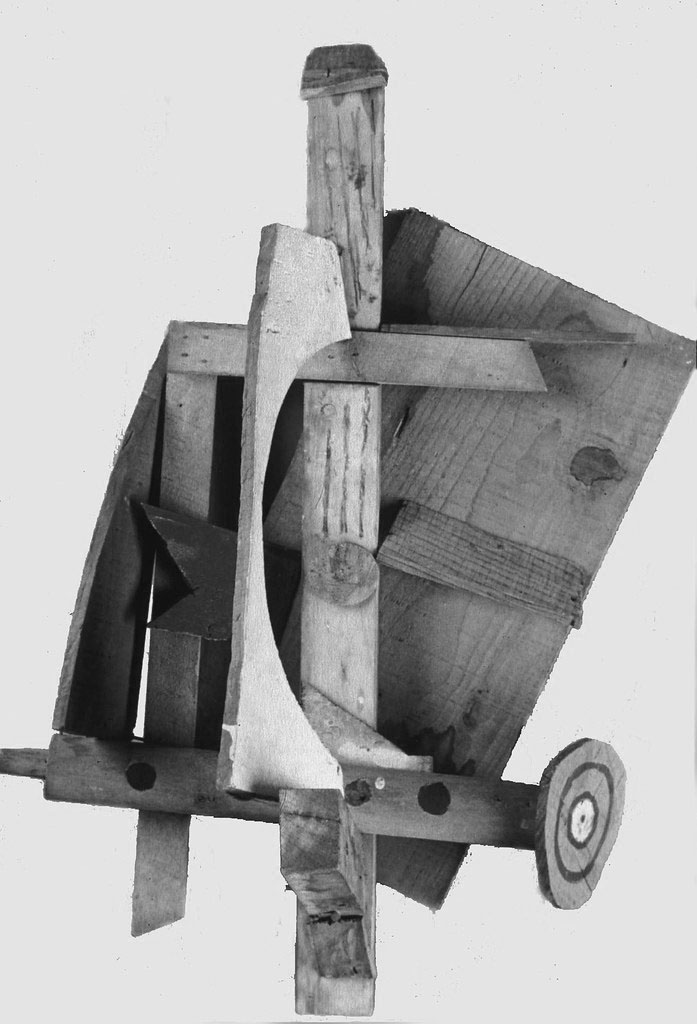
Through intuitively working by hand, the participants create physical embodiments of the ideas dwelling within their imagination. Whilst enriching their design tool palette, a participant also enquires into the psychological forces behind the creative process and becomes more aware of themselves as a maker. Rather than architectural models, the resulting objects will be closer to abstract sculptures or arkhitektons*.

Above: Horizontal Arkhitekton, Kazimir Malevich, c. 1925

Footnotes:
*Architectons are experimental architectural sculptures made by Kasimir Malevich in the 1920s (Colquhoun, A. 2002)
Bibliography:
Colquhoun, A. (2002). Modern architecture. Oxford University Press.
Gombrich, E. H. (1972). Art and illusion : a study in the psychology of pictorial representation. Princeton University Press for the Bollingen Foundation.
Jung, C. G., Adler, G., & Hull, R. F. C. (1970). Collected Works of C.G. Jung. Vol. 14, Mysterium Coniunctionis (Course book. ed.). Princeton University Press.
Jung, C. G., & Chodorow, J. (1997). Jung on active imagination. Princeton University Press.
McNiff, S. (1998). Jung on Active Imagination. Art therapy, 15(4), 269-272.
Pintilie, I. (2013). The Aesthetics of Matter; Materiality and Dematerialization in Paul Neagu’s Work. In S. Posman, A. Reverseau, D. Ayers, S. Bru, & B. Hjartarson (Eds.), Modernism, the Avant-Garde and Material Exchange (pp. 221-234). De Gruyter. https://doi.org/doi:10.1515/9783110317534.221
 no.balsa