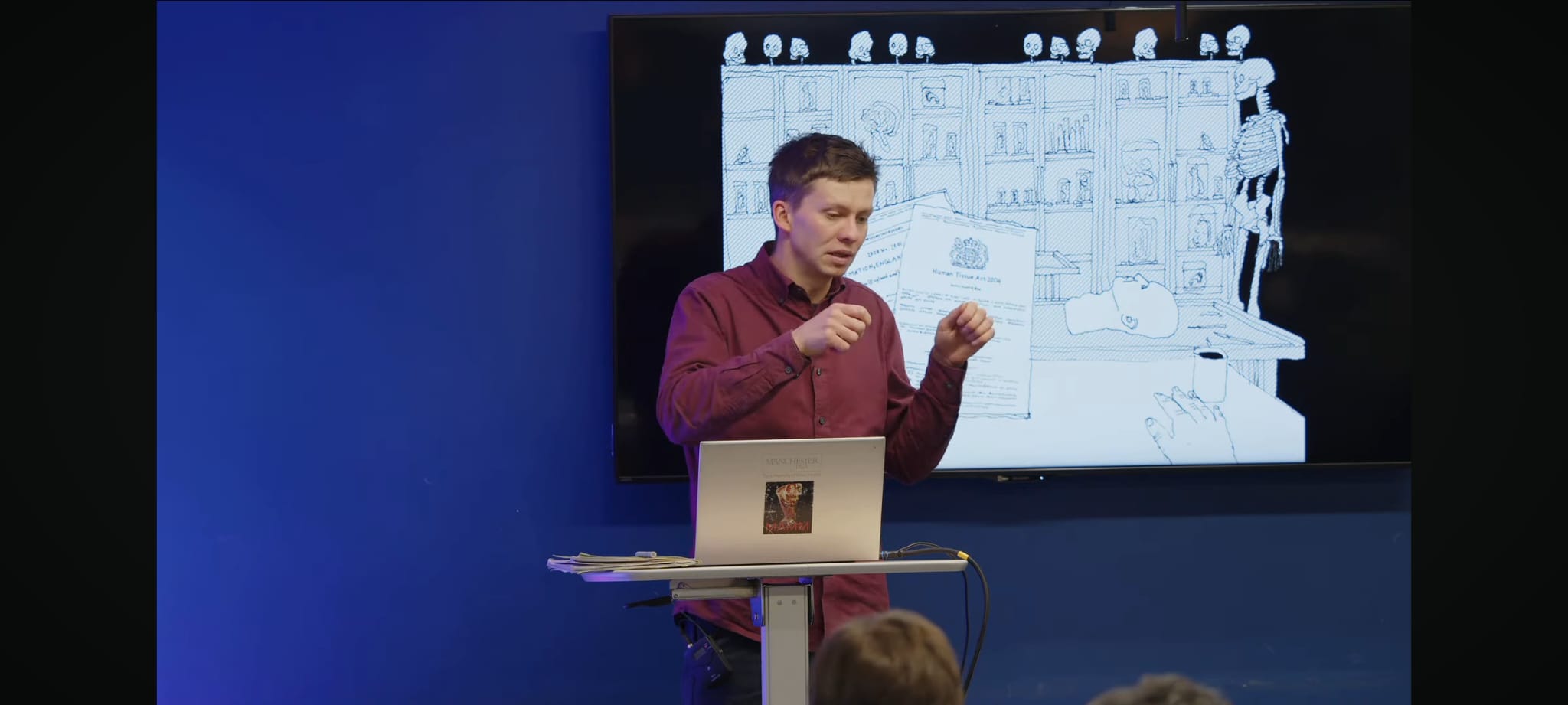
On 5 December 2025 I gave a talk for the STS department at Virginia Tech, Blacksburg, USA. The talk covered the use of drawings as a method for representing the commodification and disposal of donated body parts. Scroll down for my talk’s video recording and abstract.
Abstract
Given the regulatory loopholes and restraints associated with cremation and human tissue handling in the United Kingdom, the anatomical specimens imported from the United States for research, testing and surgical training, once unusable, end up being destroyed at facilities designated for burning miscellaneous waste. A drawing-based ethnography of these disposal practices reveals respect towards the dead body to be a set of business-to-business services, contingent upon situational constellations of industrial spaces, machinery and human labour. Focus group workshops with these incinerators’ workers, reflecting on the under-regulated disposal procedures, indicate a conflict between the intentions behind efficient waste destruction and those behind respectful mortuary rites.
Sandwiched between the diverging interests of sanitary and moral cleansing, the waste workers self-alienate from the anatomical specimens they are incinerating, making the latter alienated from their former human selves. Applying Giorgio Agamben’s perspective on law incarnating the body, the research evidences a process of post-mortem stripping of the human body from its civic status. Using John Troyer’s angle on necro- and thanato-politics, I evaluate the injustices created through the corpse’s transatlantic commodity geography. Based on this, I argue for the importance of industrial machinery and labour for the overall operation of scientifically and financially benefitting or suffering from commodified bodies. Using a novel drawing-based method for studying the relationship of industrial work and human remains, the study takes a new angle on studying body remains rendered waste, contributing to the perspectives on the infrastructural commodification of the corpse, applicable in radical geography, medical humanities and science and technology studies.

 no.balsa