

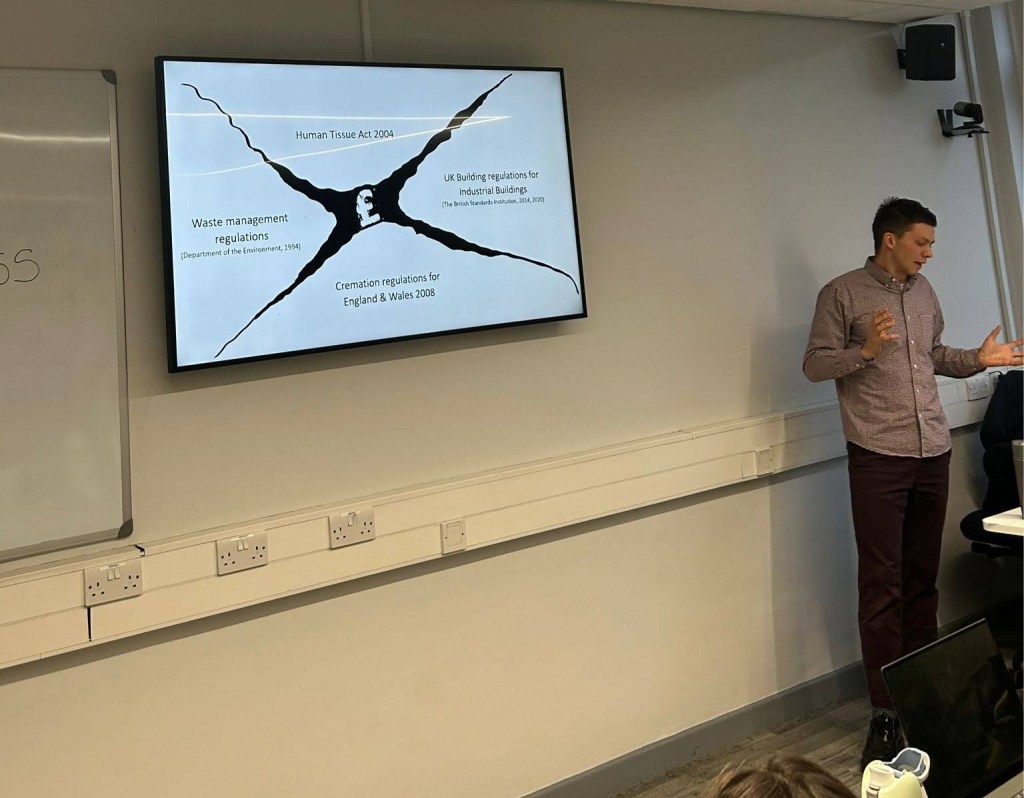
As part of my TA work with Ben Blackwell on the Architecture of Authority course for 3rd year undergraduates, I gave a talk on the biopolitical and necropolitical relationships vested in waste infrastructure. Using concepts from Foucault, Agamben, Bentham and others, the course explores authority and architecture through historical and contemporary building typologies including the prison, the workplace, the school, and the architectural icon.
Using Agamben’s (1998) and Troyer’s (2020) recent contributions to Foucault’s doctrine and drawing on the findings of my PhD, I discussed the incinerator as a space entangled in necro-, bio- and thanato- political relations, extending far beyond the incinerator sites.

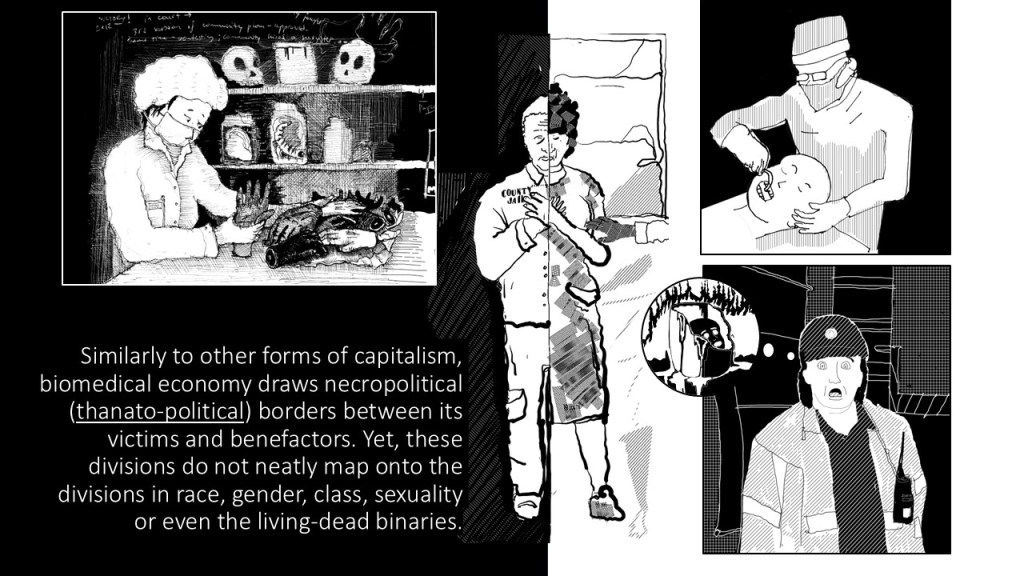
The scientific and economic networks, created by the human tissue economy subvert the conventionally understood distinctions between funerary, mortuary and industrial spaces. Instead, these divergent domains are pieced into clandestine specialist networks.
Following a subsequent presentation at Virginia Tech, I am examining these power relations in more detail in an STS article that will be coming out in 2026.
Sources cited:
Agamben, G. and D. Heller-Roazen (1998). Homo sacer : sovereign power and bare life; translated by Daniel Heller-Roazen. Stanford, Calif, Stanford University Press.
Foucault, M. and R. Hurley (2019). The history of sexuality. / Volume 1, The will to knowledge. London, Penguin Books.
Troyer, J. (2020). Technologies of the human corpse. Cambridge, Massachusetts, The MIT Press.

 no.balsa