
In October 2021 I commenced on a PhD at the University of Manchester. The topic of the PhD is on facilities for managing municipal solid waste. The primary question of my research concerns the principles how they operate, the real-world constraints they face, their industrial context, how they are planned and built, as well as any cultural value they bring as urban and infrastructural elements. As part of my PhD I have been undertaking academic placements at KTH (Stockholm). The research builds on my very first enquiry into waste undertaken 6 years ago (link to post), as well on a number of other research initiatives undertaken over the years.
A brief outline of the research is summarised below:
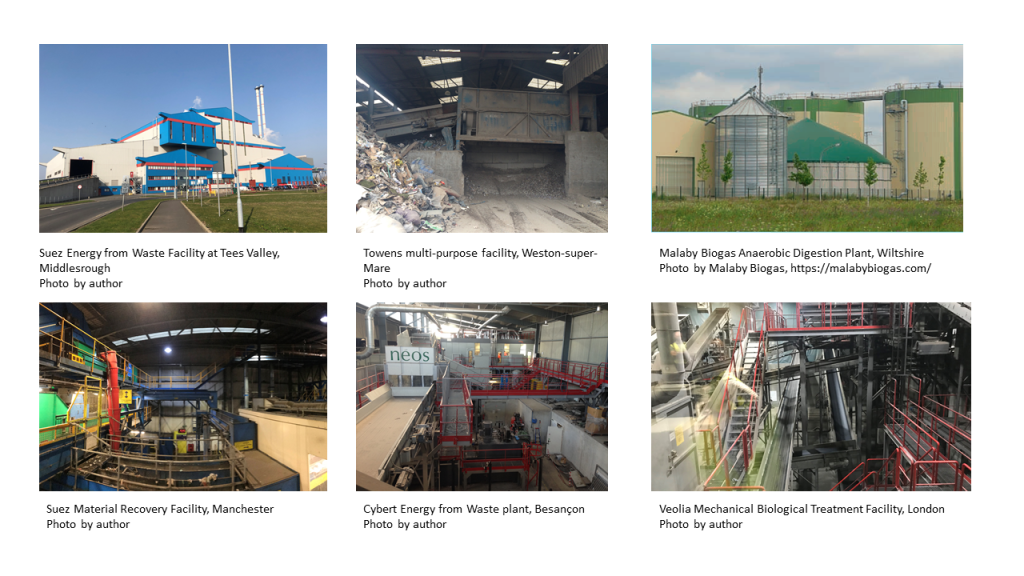
This research responds to the hypothesis that municipal solid waste (MSW) should be treated close its source, i.e. close to or within urbanised areas. The research concentrates on facilities used for managing the prevalent types of rubbish, such as general (black bag) waste, mixed recycling and food waste. These facilities include material recovery facilities (MRF), Energy-from-Waste incinerators (EfW), and Anaerobic Digestion plants (AD). The research also takes into consideration potential up-and-coming treatment technologies, such as gasification and pyrolysis, which will require different types of facilities.
The research seeks to answer the following questions:
- Why are SWM management facilities located predominately away from places where people live and work?
1a) review historic social, and legislative context
1b) review the role of SWM facilities
- What would be the environmental, logistical and social outcomes of bringing waste treatment facilities into urbanized areas?
The overall aim of the project is to provide authorities and enterprises involved with SWM with tools and principles to help plan, build and manage facilities for waste management in socially sensitive, technologically robust and sustainable ways, most importantly in the correct locations.
Research builds on the review of existing literature and practices, as well as a case study deploying a set of methodologies identified and developed over the course of the project.
Literature gaps identified so far: society’s relationship with infrastructure for MSW, research practices for planning and designing new facilities which can be applied by authorities and enterprises (much of existing academic research is complex, wordy, case-specific and is used/understood only by academics), ways to plan and design facilities for emergent technologies (eg. gasification, pyrolysis), ways to adapt old disused facilities, philosophical outlook on waste management which accounts for various technological processes within the industry.
Methodology
The intended methodology includes Life Cycle Assessment (LCA), Material Flow Analysis (MFA), Sankey Diagrams, and Mathematical Models. Application of either would involve both positivist and constructivist approaches. The former would entail gathering empirical data from MSW disposal operators and authorities. This would be data about waste tonnages and flows for a selected case study region, as well as current principles for regulating, planning, designing and operating facilities for MSW. The constructivist approach would require obtaining the subjective perspectives from stakeholders who may be affected by existing or new MSW facilities and processes, as well as developing my own positionality on the matter. Both approaches would require interviews, access to data possessed by authorities, developers and operators, potentially surveys.
Spatial Material Flow Analysis (SMFA) involves learning data collection and processing suitable for a range of research activities focused around infrastructure planning, material flows and urban metabolism. It is planned to test the SMFA methodology in collaboration with the Industrial Ecology research group at the KTH Royal Institute of Technology in Stockholm over the course of April and May 2022. Given that immense variation of world-wide waste management practices and facility types, depending on climate, prevalent waste categories and quantities, urban and architectural typologies, economic levels and other factors, the project scope needs further refinement for a typical or an extreme case location to be selected.

 no.balsa
1 Comment