
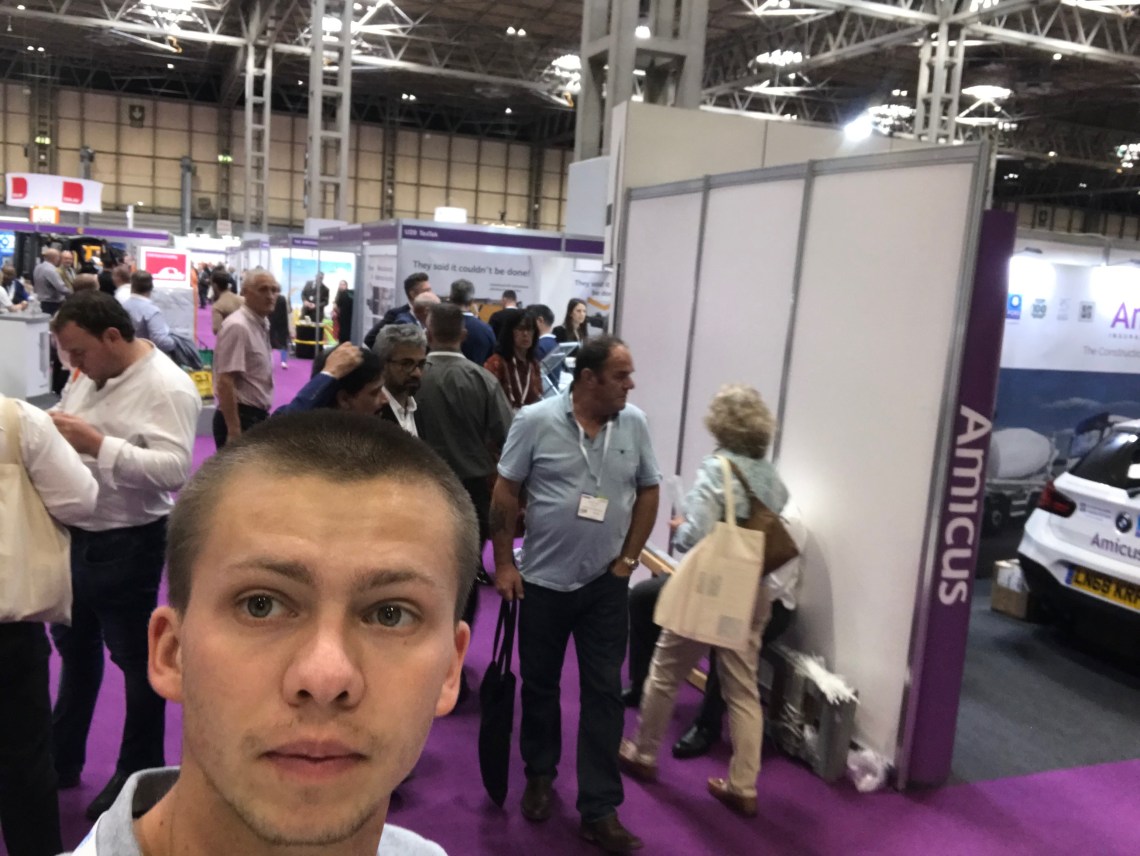
Below I review some professional functions that link the fields of waste management, architecture and urban planning, based on my observations at the exhibition RWM 2019. I also discuss certain related obstacles with positioning industrial plants close to cities and towns.
Facility designer: UK WM companies (Suez, Viridor, Veolia, etc) typically subcontract the design to a specialist architecture firm (eg. Grimshaw, McAslan, S’pace) and in parallel employ a business specialised in waste logistics to get the high level technical design right: facility size, orientation, relationship to transport links. In the U.K. Fitchner, Ramboll, Jacobs and Mott McDonald are amongst such consultants. Specialised planning consultancies such as Peter Brett assist with planning submissions.
Within the large Waste Management enterprises there is are internal departments that oversee construction and planning of facilities: for example at Suez: development team, property team, construction team and legal team within the latter to assist with planning applications.
Finally the local authorities initiate the urban plans that prescribe the locations for building waste treatment infrastructure. Without such initial provisions in place it is unlikely to succeed in making an application for a site. At times partnerships between the local authorities and enterprises result in successful Eco park projects, such as Binn Group’s cluster of facilities built in the last 20 years on former farmland 7 miles outside of Perth.
With electricity-generating plant, 50 megawatt is an important threshold. For facilities producing over 50 MW, a national infrastructure planning submission to the Secretary of State needs to be made. This takes longer to get approved, however helps to bypass local authorities potential resistance to waste treatment plants. Suez’s CEO David Palmer-Jones pointed out the 50MW threshold remains a significant obstacle on the way of implementing smaller local Energy-from-waste facilities, due to authorities not willing to accept industrial facilities ‘in their backyard’. Implementing a centralised energy generating facility such as one in Malmö, Sweden, remains an unfulfilled dream for the U.K.’s waste managers.
Opportunities for an architect to learn about waste management.
Purchasing the CIWM membership (£100-£150 per year) enables one to have an advisor from the institute to guide one with knowledge about different segments of the industry and choose an aspect one would like to specialise in. Once a specific function within the profession is targeted, a suitable qualification can be obtained by passing the relevant exams. CIWM advisor also assists with finding a mentor within the industry, who would facilitate with visiting plants, learning about relevant technological, managerial and legal systems.
During the ‘Future Skills’ discussion in RWM 2019 some speakers noted the ‘transferrable skills’, mainly focused around technology, that can be brought into waste management from other fields. What are such transferrable skills an architect might have? This may be to do with the industry moving away from ‘cheap and cheerful’ (eg. infrastructural projects ticking the minimum requirements at lowest costs) towards the higher quality standards achieved through long term business partnering. In fact, partnering construction contracts* may be most suitable for such projects.

 no.balsa