Today I leave Lagos, Nigeria, where I spent the last two months. Below is a little summary of my thoughts and experiences. During my time here I tried to maximise my effort to sample a cross section of the different lifestyles and conditions. I experienced a variety of spaces from a fisherman’s hut to a 400 sqm president’s sweet and met a wide range of people, from an indigenous Baale (prince) soon-to-become Oba (king) to a federal minister.
Lagos stretched my appreciation of how much the basic amenities and high level of life and health security associated with the day to day activities are taken for granted in the global North. For most people in Lagos having a sufficient income to sustain themselves involves being constantly exposed to various levels of health risks and personal insecurity.
People working in such environment display incredible degree of productivity, creativity and improvisation. Based on my interviews with employers these qualities appear to diminish when a Nigerian is no longer faced with life endangering environment of working on the street or on the water when moving onto an office or a shopping centre job.
Lagos is where the value of time is as variable, as that of Naira, the local currency. People gladly occupy jobs requiring them doing nothing for long hours, just to avoid being part of the everyday quest for survival. People strive to remove themselves, both physically and psychologically from the everyday ‘hassle and bussle’, the essence and economic motor of today’s Lagos. A real estate researcher I interviewed mentioned to me that ‘Nigerians don’t value their time’.
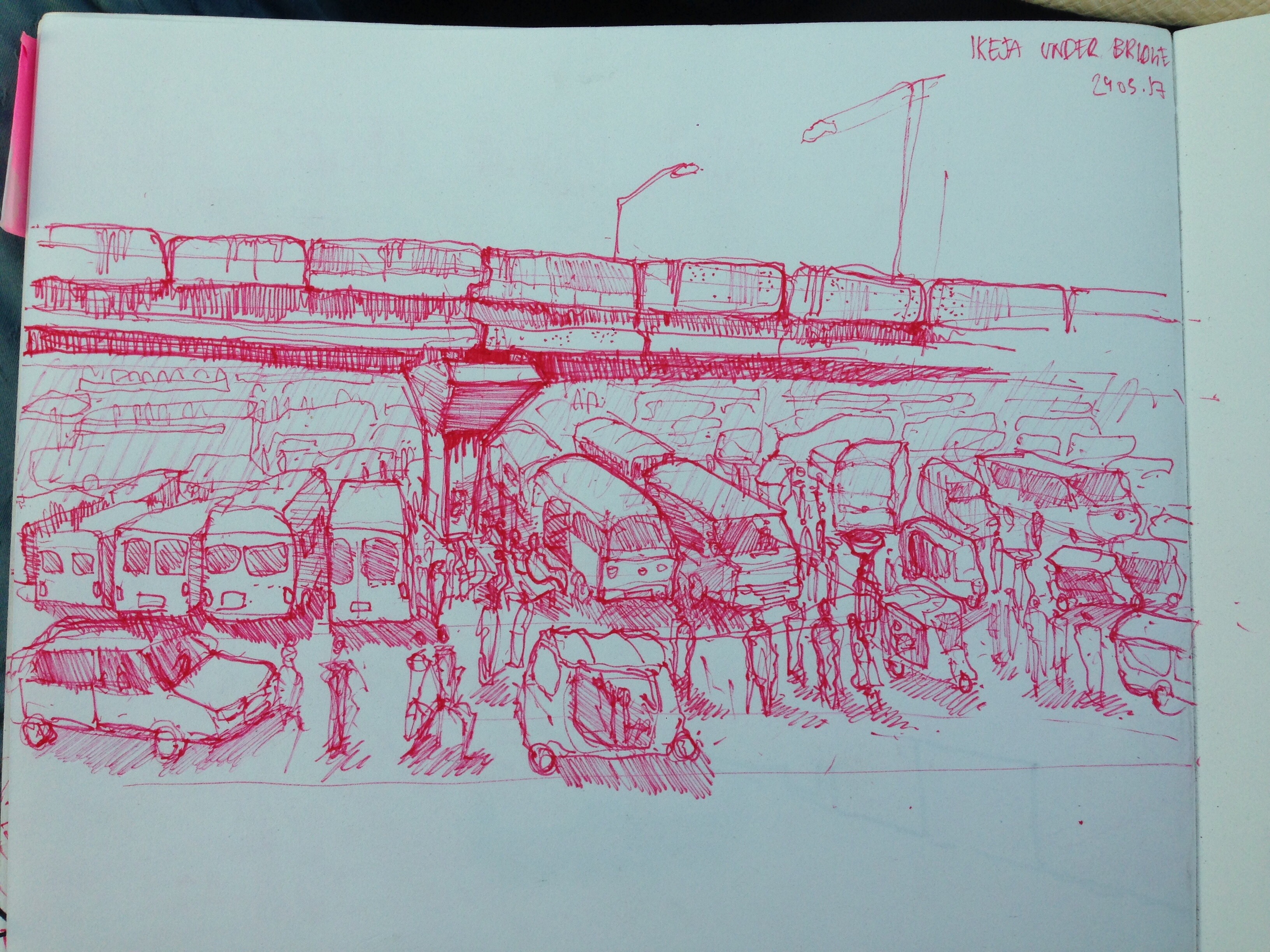
I look through the taped and dusty airport window at the city, where I witnessed street fights and shootings both before and after having gained enough ‘Lagos experience’ to ascertain the level of danger I am in. This city offered me a different experience, whether I navigated it by foot, ocada-motorbike, danfo-minibus, Uber-taxi, private motor-boat or a big black SUV.
I also leave Nigeria, a country blessed with enormous supplies of ‘sweet’, orangy-transparrent crude oil, beautiful landscapes, heavenly tropical climate ‘where everything grows’ and great cultural diversity, overwhelming in Lagos alone. The multitude of cultural, tribal, religious and other influences continue generating a unique spectrum of different human appearances, with an athletic body and non-ageing face being a dominant feature amongst all.
To my joy and excitement, I found most Nigerians to be proudly black, mocking the awkward and cautious oyimbos (unless the oyimbo = white man is their boss). Nigerians make good and exhaustive use of foreign objects and ruthlessly vandalise and appropriate to their needs anything imported, be it the English language or a Volkswagen Transporter minibus.
As many other places, Nigeria is a country of unexpected contrasts, where a village child resumes a recent animation movie on a DVD player, having just publicly eased oneself into an open drain of a muddy lane meandering around the shaky bungalows. Throughout my time here I was trying to use social media and this blog to communicate to my friends and colleagues how the life in Nigeria is different, yet in many ways surprisingly similar to the ambiguous ‘normal’ life as perceived by a northerner.
Today I say ‘see you later’ to a place where a curious researcher like myself patiently waits for the magical morning of waking up and not experiencing fever, headache, suspicious spots on the skin, stomachache, itching or a sudden need to run to the WC.

 no.balsa